
Indoor plants
The problem of managing indoor plants is that the environment we create in our homes, the most comfortable possible for us and ours, does not mean that it is the most suitable for our plants.
The main problems are determined by:
1. Lack of light. Our indoor plants need sunlight to perform photosynthesis, although some more than others; a clear symptom of lack of light is chlorosis and subsequent fall of the leaves. Another symptom that they manifest if they do not have enough light is the elongation of their stems in an attempt to reach it, producing the phenomenon known as ahilamiento (long and weak stems). We must place them in those places of our house in which, without directly affecting them, they have access to enough light.
2. Water needs. Our indoor plants, not being subjected to the effects of the wind and the effects of direct solar radiation, will not have the same rate of transpiration and therefore water consumption with which we run the risk of overwatering and rotting the root. We must calculate the irrigation endowment as we have already seen, but we must bear in mind that the frequency of irrigation will be much lower than that of a similar plant grown outdoors. We will use ceramic pots instead of thermoplastic, since the former have a greater porosity and therefore a greater evaporation of water; growing media will have good drainage.
3. Ambient humidity. Most houseplants come from tropical and subtropical areas where the relative humidity is very high. In our geographical latitude it is difficult to achieve this environmental humidity for our plants so we must act in two ways:
• Apply foliar sprays.
• Put the pot on top of a plate or container filled with gravel so that the drain does not touch the pot, but when it evaporates slowly it forms a microclimate a little wetter than the rest of the room.
4. Temperature. Our indoor plants, although they can withstand temperatures between 10 and 30ºC, are comfortable in a temperature range that can range from 15-25ºC; what we must avoid are the sudden changes in temperature caused by drafts, air conditioners and heating.
5. Change of pot. When our pot can not contain our plant we must change it to a larger one and take advantage to change as much substrate as possible. We will take advantage of the less active periods to make the change since this is a serious stress for the plant.
6. Nutrition. We will continue to nourish each time we provide water with a complete and balanced solution that provides our plants with primary macronutrients, secondary macronutrients and micronutrients, continuing with our controls of electrical conductivity and pH of our fertigation solution and drainage.

Orchid


For me it is the queen of indoor plants and I will show you that it is not difficult to keep them in perfect condition for many years.
Orchids are perennial herbaceous plants of the orchid family that come from the intertropical zone of the earth. They can be terrestrial or epiphytic, and occasionally climbing. Epiphyte or epiphyte refers to any plant that grows on another vegetable or object using it only as a support, but does not parasitize it nutritionally. It is only a mechanical parasitosis, and the tree or object that acts as a support is a host of mechanical parasitosis. With regard to epiphytic orchids, it is said that they can become eternal.
We are going to look at the orchids belonging to the genus Phalaenopsis, better known as butterfly orchid. It comes from Southeast Asia and is an epiphytic variety; it lives in semi-shade in the upper parts of trees feeding on rainwater and organic matter that is deposited on its hosts. Its flowers are white, pink or magenta, but lately other colorations are being achieved through hybridizations. Its leaves are elongated, of an intense green and with a very marked central nerve.
As for its cultivation in our homes, we must bear in mind that it is a plant that performs photosynthesis both in the leaves and in the root. Hence the reason for placing them in a transparent pot.
The substrate is special; we can not cover its roots with the typical substrates that we use with our other indoor plants or we would suffocate it. A good substrate could be a combination of:
-
A layer on the bottom of rambla gravel.
-
An intermediate layer of mixture of sphagno moss and perlite.
-
A thin layer of charcoal.
-
A surface layer of pine bark.
The layer of gravel will give stability to the pot since the floral rods of orchids give the plant a height of 60-70 cm. The layer of moss and perlite will act as a moisture and nutrient retainer. The carbon layer will act as a water filter and as a bactericide-fungicide. Finally, the layer of pine bark acts as a thermal insulator. Charcoal is charcoal that we use in our barbecues, but we must take the precaution of washing it several times until the water comes out clean. We can do it with a pasta drainer of those we have in all kitchens.
Flowering occurs in late winter or early spring and consists of a floral rod (or two) with buds from which the inflorescences will emerge.
This floral rod must be tutored to prevent it from bending with the weight of the flowers. We must bear in mind that if there is no difference of 5-7 degrees between the day and night temperature (what we know as day/night thermal oscillation) the plant will not bloom; this can be forced with some kind of artificial light during the day or by changing the plant to a colder site at night.
They are plants that need light, but we should not expose them directly to the sun or they would burn. They need well-ventilated rooms, but it is not good for them (as for most indoor plants) drafts. They withstand temperatures between 15 and 30ºC, but are more comfortable between 20-25ºC.
They require a relative humidity of between 50 and 60%. In times when it falls below the minimum value (in winter with the heaters and in summer with the air conditioners) we will put a plate with a layer of wadis gravel under the pot to collect the drainage water which, when evaporated, will help increase the relative humidity around the pot. This dish should always have a film of water. This system is better than spraying water on them, as it can damage the flowers.
They are watered like all plants, but when to water them will be indicated by the color of the root:
• If they are green it means that they still have enough moisture and endure without watering.
• If they turn whitish it will be time to water them.
• If the root turns brown, the plant will be telling us that we are overwatering it.
We will apply water on top with its respective balanced nutrient solution. From time to time we can water it by immersion, immersing the pot in the fertigation solution without wetting the aerial part.
In many blogs we are told that tap water damages it; using a balanced solution in ions as we have seen above and draining well we will not have problems, unless we use a water with excessive electrical conductivity.
Arrived in the summer the flowers will wither and it is time to make the decision of whether to force a second flowering (smaller than the first), or on the contrary cut the floral rods from the base:
-
In young plants, first or second flowering (2-3 years of age), the most indicated is to prioritize the vegetative growth of the plant over a second flowering; therefore we will cut the floral rods at the end of the spring flowering by the base, without leaving any knot or bud above. With this we manage to take away from the plant a very important expenditure of nutrients and photo assimilated (the reproductive organs of the plants are the ones that monopolize most of the energy, nutrients and reserve substances; that is why we call them «sinks»), enhancing the vegetative growth of the plant and guaranteeing a good flowering the following spring. Once the rod is cut, we will continue watering with our fertigation solution as we did before.
-
On the contrary, in plants of more than 3 or 4 blooms, with a well-developed root system and an aerial part, the flower rod can be cut above a bud in good condition and force a second (smaller) flowering.


After the second flowering, then if we will cut the rods by the base. In both cases and throughout the crop cycle we will eliminate the basal leaves that wither, cutting them at the base.
It is very important to make a change of substrate every year and incidentally we will take the opportunity to change to a larger pot in case it was necessary. The change must be made once the flowering is finished and in the period of winter rest of the plant; late autumn first of winter.
Orchids can reproduce in different ways:
1. Reproduction by keikis. A keiki is the spontaneous birth of a new seedling from a knot of a floral rod. It is an asexual reproduction.
Although as we have said, it occurs spontaneously, we can help induce it in a certain way: two or three weeks before the start of the process we will water our plant with a solution poor in nitrogen and rich in phosphorus and potassium. Once the floral rod is cut above a knot, remove some bark around it to leave the cambium exposed and apply hormones. We can help you by removing some light in the knot area. We will place the plant for a few weeks in a cool place and then move it to a climate between 20-25ºC. Once the new seedling is sufficiently developed, it is cut and transplanted into an orchid substrate.
2. Reproduction from cuttings of the floral rod. It is also a way to asexually reproduce our orchids. As we did with keikis, two or three weeks before the start of the process we will water our plant with a solution poor in nitrogen and rich in phosphorus and potassium.
Once the floral rod is cut in its entirety after flowering, we cut it into as many pieces as knots with viable bud has (5-7 cm). We put the knots in water with a very dilute nutrient solution poor in nitrogen (no ammoniacal nitrogen) and rich in phosphorus and potassium and let it hydrate for a few minutes.
Once hydrated we remove a little bark near the knot, spread on rooting hormones and cover them partially and horizontally with a rooting substrate (coconut fiber, peat with sand, etc.). We will place the container with the cuttings in a cool and dark place and avoid excessive evaporation by covering the container with transparent film. We will spray with water when we see that you need it.
Once a few weeks have passed, we will take the container to a place with temperatures between 20 and 25ºC. Once the roots have been emitted, we will transplant it into an orchid substrate. It will emit flowers in about two years.
By either of the two forms of reproduction that we have seen we will not have flowering, if all goes well, before two years.


African Violet


Perennial herbaceous plants of the gesneriaceae family native to the tropical zone of southeast Africa (Tanzania and Kenya). It is a plant that tends more to grow horizontally than vertically, creating a structure 5-15 cm high and 10-30 cm wide. The leaves are round or oval, fleshy and slightly hairy. The flowers are velvety and with 5 lobes and appear in clusters of 4 to 12 on a thin stem.
As for the color, this can be blue, white, light pink, deep pink and dark purple. Flowering occurs throughout the year after which the flower stems are pruned.
An ideal substrate would be 70% blonde peat and 30% worm humus. It is not necessary to transplant it since it is not demanding in terms of the volume of substrate; do it every 2-3 years and in order to renew the substrate.
It is very sensitive to botrytis so we must be very careful with irrigation: we must water it from below by immersing it in a plate with water for 20 minutes until the water ascends by capillarity. If we water it from above we run the risk of damaging the aerial part. It is demanding in fertilizer.
We will place it in a bright place but protected from direct sunlight and drafts. It needs temperatures between 15 and 25ºC. It requires a high environmental humidity (50-60%) for which we will place a plate with gravel under the pot: WE WILL NEVER SPRAY WATER ON IT.
Remove dead leaves and wilted inflorescences to prevent fungal diseases.
It is multiplied by division of the plant or by leaf cutting; cut a leaf with its petiole in autumn and put it in a substrate conducive to rooting or in a glass of water.
Anthurium
Anthurium is a perennial herbaceous plant belonging to the araceas family and a genus with more than 500 species. Of these, the anthurium scherzerianum stands out, mainly dedicated to its cultivation as a potted plant and widely used as a cut flower.
It is native to the tropical areas of Colombia, Ecuador and Central America. It is commonly known as flower of love or anthurium. The anthurium flower has become the emblem of Hawaii, one of the main production areas along with Ecuador and Colombia. In Europe, the largest producer country is the Netherlands.
It is within the group considered as a purifying plant, capable of purifying the air from where it is found of harmful substances.
It has a superficial root system. The trunk becomes woody as the years go by. The leaves grow alternately and can be oval, arrow or even heart shaped. They should be cleaned with a damp cloth when we see that dust has been deposited on them.
What we know as a flower is nothing more than a spathe, that is, a modified leaf; on the basis of this spathe appears the true flower, called spadix. They are very durable and when they are prepared to be fertilized a shine appears on their surface that would make them confused with artificial plants. Its main shades are red, white and pink, but lately new colors such as apple-green or chocolate are being achieved. Flowering occurs from spring to summer and in tropical areas throughout the year. Due to their weight they will often need a tutoring.
It needs a substrate 50% blonde peat, 25% sand and 25% worm humus. Every one or two years you should change the pot and renew the substrate, always at the end of winter. It needs indirect lighting so it should be near a window, but without receiving direct sunlight.
It withstands a temperature range between 15 and 30ºC, but is more comfortable between 20-25ºC. It does not sit well with drafts and does not withstand low temperatures. It is demanding in terms of water and fertilizer needs.
The main problem of its handling is that it needs a very high relative humidity so that it has a long flowering period, but this is not solved by watering excessively since it does not withstand root waterlogging. To alleviate this as much as possible we will spray water on the plant (if it can be mineral or even distilled, better than that of the tap) and we will have under the pot, as we have seen before, a plate with gravel that collects the drainage water which when evaporated will help raise the relative humidity to the environment immediately next to the plant.
It does not require pruning, simply cut the leaves and flowers withered from the base. Use well-sharpened and disinfected scissors, with precise cutting, diagonally and without starting to avoid hurting the plant.
The most commonly used form of propagation is asexual, by cuttings or offspring. When we see that stems of the substrate come out or aerial roots are noticed, it will be time to separate the new seedlings from the mother plant and plant them in a separate pot. It is done at the end of winter and we can take advantage of the years in which we change the substrate and / or the pot.


Monstera Deliciosa (Adam´s Rib)


They are evergreen climbing plants that in their natural state can grow up to 20 m supported by trees. Its range includes rainforests from Mexico to northern Argentina.
It belongs to the family of araceae and the most representative of its genus are the monstera deliciosa and the monstera adansonii. They differ in the height of the plant (taller in delicious), in the size of the leaves (smaller in adansonii) and in the shape of the holes of the limbus, more rounded these in adansonii.
The leaves are alternate, of intense green color, very large and with holes in the limb, hence its name of Adam’s rib. It is thought to be an adaptation to areas with strong winds. In the natural state some species produce an edible fruit in the form of a white berry. It is a toxic plant so we must be careful with pets and children.
It is a resistant species that adapts well to live both outdoors (semi-shade) and indoors, although in this second case it must be located in a bright place. It should not give you sunlight directly or it could cause burns.
It withstands temperatures between 15 and 30 º C, although, like all tropical ones, it is comfortable between 20 and 25 ºC; below 15 º its growth slows down and below 10º it paralyzes. It does not tolerate frost.
The substrate, the one we already know: 50% blonde peat, 25% sand and 25% worm humus. Like the tropical ones, it needs water, but with good drainage. Balanced subscriber throughout the year.
It is advisable to apply water from above as if it were a rain; if we have a garden we will do it outside with the hose and if we can not put it in the shower or in the bathtub.
We will change the substrate every two years, expanding the pot proportionally. We will do it at the end of winter and we will take the opportunity to prune the roots in poor condition. We can choose to tutor it, for which we will guide the aerial roots to the tutor so that they cling to it, or if we do not want to tutor it we will guide them to the substrate so that they penetrate it.
Reproduces asexually by cuttings; when we see aerial roots on a stem, we will cut it 3-4 cm below and introduce it into a container with water that we will renew weekly.
When white rootlets appear under the aerial ones it is time to pass them to their pot.
Calatheas
Perennial herbaceous plant of the marantaceae family from Brazil and Peru. Its root system is rhizomatous and (later we will see how to reproduce it) reaches a height (in pot) of 50-60 cm. The leaves have an extraordinary color with alternation of greens, yellows, whites and silvers on the beam and pinks and purples on the underside.
There are many varieties of calathea:
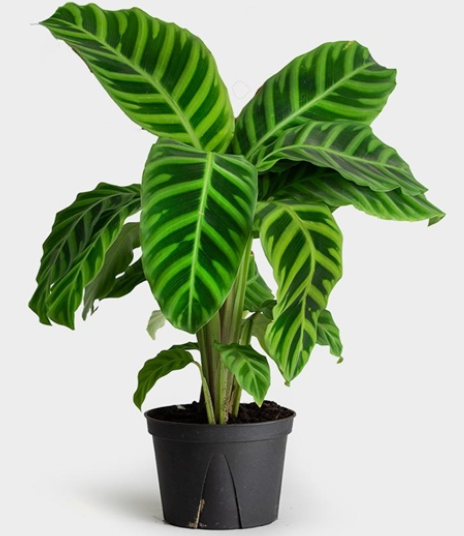
Calathea Zebrina
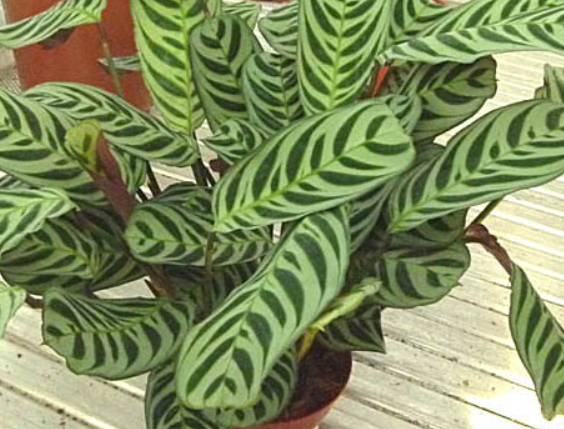
Calathea Mackoyana

Calathea Orbifolia

Calathea Warscewiczii

Calathea Picturata

Calthea Roseopicta

Calathea Ornata

Calathea Triostar
It is a hardy plant and as a tropical plant:
• Can be both indoors and outdoors.
• Slightly acidic substrate with good drainage: 75% blonde peat and 25% worm humus. During the first three years of life the substrate will be changed every year at the end of winter. From the third year the substrate will be changed every two years.
• Demanding with water and fertilizer, but does not withstand waterlogging.
• Outdoors we will place it in semi-shade. Inside the house we will look for a well-lit place, but without direct incidence of the sun.
• Requires high relative humidity. We will place it on a plate with gravel.
• Temperature range between 15 and 30ºC, but feels more comfortable between 20-25ºC
• Cold drafts do not suit you.
• Leaves should be cleaned of dust with a damp cloth.
• Do not wet the leaves with watering.
They do not need pruning, simply remove the withered leaves by cutting them by their base with a very sharp and disinfected utensil.
It reproduces by splitting the rhizome at the end of winter.

Poto (Photo)


Another perennial herbaceous plant of the areaceae family. Climbing in size, it can reach 20 meters in height in its natural state. Use the aerial roots to climb.
The leaves are alternate heart-shaped and can be green, yellow, white and variegated.
It is one of the effective plants in the fight against indoor environmental pollution, eliminating formaldehyde, xylene and benzene.
We can tutor it to grow from bottom to top or as a hanging plant; in the first way the leaves will be larger.
It is a fairly hardy plant. You need a substrate that can be simply 70% blonde peat and 30% worm humus. It is not very demanding in terms of irrigation and fertilization; in this plant it is better to sin by default than by excess. It grows well in a temperature range of 10-30ºC, although the ideal is 15-25ºC. Below 8ºC it stops its vegetative growth.
One of the most important aspects to keep the pot healthy is lighting; being a plant with many leaves, it needs spaces with a lot of indirect lighting. When we see that the color of the leaves of our pot becomes a uniform green color (it loses the yellow variegated) it will be telling us that the lack of light. The lack of light leads to long and weak stems.
The second aspect to take into account is the ambient humidity; having a large leaf surface requires a lot of environmental humidity so as not to transpire excessively and have a proportionate growth. To maintain a good environmental humidity, mainly in summer and winter, we will spray water and put a plate with gravel under our pot.
Although you can read that it is an undemanding plant in fertilizer that does not mean that it does not respond with an exuberant growth to the contribution of a nutrient solution properly balanced with primary and secondary macronutrients and micronutrients.
As for pruning management, it will simply come down to removing old or spoiled parts of the plant.
To reproduce a pot we will cut the stems below a knot (if the pot has growth upwards, above the knot if it is a hanging pot) and we will clean the leaves of the stem leaving only the two or three of the distal end. We put the stem in a glass with water and a solution rich in phosphorus and potassium (which we will renew weekly) and when the white rootlets appear we take it to the substrate. If we want a leafy pot, which is not long, we will cut the stems to a certain length and plant them in the same pot in order to achieve a growth in volume. If we let them grow a lot we would have very long stems, thin and with a lot of space between leaves.
Brazil Trunk (Dracena)
Perennial tropical shrub belonging to the asparagaceae family, scientific name dracena fragans and native to East Africa (Tanzania and Zambia). Slow-growing and vertical plant, in nature it can reach more than 5 m in height. Large, hanging leaves of green and yellow color in the nervial area; as it grows, it loses the lower leaves leaving a very decorative robust stem bare. They can produce a stem with numerous star-shaped, cream-colored flowers in the summer months.
It is another effective plant in the fight against indoor environmental pollution, eliminating formaldehyde, xylene and benzene.
It needs a substrate 50% blonde peat, 25% sand and 25% worm humus. Every two or three years we should renew the substrate, always at the end of winter. They live better in small pots than large ones.
It needs indirect lighting so it should be near a window, but without receiving direct sunlight. It withstands a temperature range between 15 and 30ºC, but is more comfortable between 22-26ºC. Below 14º it stops its vegetative growth and the leaves fall off. He doesn’t like drafts.
We must be careful with watering since being a plant that comes from the trunk of a tree (or shrub) does not develop an extensive root system; it is better to sin by default than by excess. You need a complete and balanced nutrient solution.
It needs a high relative humidity, but this is not solved by overwatering, as we have seen before. To alleviate this as much as possible we will spray water on the plant (if it can be mineral or even distilled, better than that of the tap) and we will have under the pot, as we have seen before, a plate with gravel that collects the drainage water which when evaporated will help raise the relative humidity to the environment immediately next to the plant.
It does not require pruning, simply cut the withered leaves from the base. Use well-sharpened and disinfected scissors, with precise cutting, diagonally and without starting to avoid hurting the plant. If by excessive growth we were forced to stop our plant, between March and April we would cut above the third knot of the green area of the trunk. If we cut through the brown area it would hardly sprout again.
The most commonly used form of propagation is asexual, by planting a piece of green trunk or terminal shoot and is done in spring.
We must be aware of the signs that the plant sends us to know how it is in health:
-
If brown spots appear on the leaves or on the green part of the trunk, it may be due to low temperatures.
-
If leaf fall occurs
-
If these have yellow edges and brown tips, it is due to a lack of irrigation.
-
If the basal leaves fall out being apparently healthy, it is due to a sudden change in temperature; it may be due to a change of place, draft, etc.
-
-
Yellow and lacy leaves: excess watering. We must wait for the surface of the substrate to dry to water.
-
The leaves become small and deformed: lack of fertilizer. Remember that we must pay every time we provide water (basic rule of fertigation).
-
Leaves with dry tips: it can be for several reasons: low environmental humidity, excess heat, lack of water or excess salts in the substrate. If it is for low environmental humidity put a plate with gravel under as we have seen before; if it is due to excess heat change it to a cooler area; if water is missing we will water more often and if it is by salts we will wash the substrate, better at night, providing twice the capacity of the pot, that is, if our pot has a volume of 5 liters, we will apply an irrigation of 10 liters of water alone.
-
Rotting of the stems: as we have seen before it can be due to low temperatures, but it can also be due to excess watering. In this case we will cut the rotten part and plant the healthy part in a very porous substrate after impregnation of rooting hormones.
-
Pale green leaves mean lack of light and/or fertilizer. You have to take it to a brighter room and pay for it regularly.
-
Brown burns on the leaves: has been exposed to the sun directly. You have to take it away from the sun and the windows.

Kentia (Howea)

It is one of the most beautiful palm trees and one of the most used as a houseplant. It is endemic to Lord Howe Island, a small island in the Pacific Ocean located about 600 km east of the Australian mainland, in the Tasman Sea. Belonging to the family of the arecaceae, it is a palm tree of arboreal and evergreen leaf characterized by a single erect and ringed stem and very large leaves, pinnate and with horizontal leaflets, and of an intense green color, darker by the beam than by the underside. The central leaves have a vertical growth and more hanging the external ones. It usually has 4 to 5 leaves per stem, drying the oldest when a new one appears. It is a very slow growing plant not usually developing more than one leaf a year indoors. It is very difficult for them to flourish outside their natural habitat. It is a plant that takes up a lot of space.
As a substrate we can use a mixture of 50% blonde peat or coconut fiber, 25% perlite and 25% worm humus. We will change the substrate (and the pot if required) every two or three years, but we must be careful with this operation: the root system does not embrace the substrate so if we pull the trunk we run the risk of breaking the root ball and the root. We must break the pot and very carefully locate the plant in its new container. Better if we can perform the complete operation inside the new pot.
It is a plant that prefers darkness to light so it is not necessary to place it in very bright places. It remains well in a range of temperatures between 20 and 25ºC, not having to fall below 15 in winter. They do not withstand the cold currents which can cause irreversible damage to the leaves.
It requires a high relative humidity (50-60%) so in times of moisture deficit (summer and winter) we will spray water on it and, of course, we will place a plate with gravel underneath that will collect the drainage water. In summer we can take it to the garden to a shaded area.
We must keep the substrate always moist, but with enough drainage. It is very sensitive to root fungi.
It is demanding in fertilizer. We will apply a complete and balanced fertigation solution.
It does not require pruning, we will simply cut the old leaves by the base taking care not to damage the trunk because there is only one and the plant could die.
It reproduces by seeds.
Salon Palm (Chamaedorea)
Belonging to the family of the arecaceae genus chamaedorea, it comprises a group of palm trees with thin stems ranging from 50 cm to more than 5 meters in height. They are native to the tropical and subtropical areas of the American continent. The most common species as a houseplant is chamaedorea elegans.
It is a very resistant plant, of low size and very slow growth. The leaves start from a single stem (if the apex is damaged the plant will die) and are composed and pinnate (which means that it is composed of flakes inserted on either side of the petiole and arranged at right angles to a central axis), up to 1 m in length, formed by 20 pairs of leaflets 15-20 cm long and 2-2.5 cm wide.
It is a resistant species that adapts well to live both outdoors (semi-shade) and indoors, although in this second case it must be located in a bright place. It should not give you sunlight directly or it could cause burns. It withstands temperatures between 10 and 30 º C, although it prefers 17-25ºC; below 8-10ºC its growth slows down and below 5º it paralyzes. It resists 3-4ºC below zero as long as it does not last long.
It requires a substrate rich in organic matter: 70% blonde peat and 30% worm humus. It is demanding in irrigation, but requires good drainage. Balanced subscriber throughout the year. It requires environmental humidity especially in summer; a symptom of lack of environmental humidity is the tips of the withered and brown leaves.
We will change the substrate every two or three years, expanding the pot proportionally; keep in mind that it does not require excessively large pots. We will do it at the end of winter.
It does not require pruning, we will simply remove the withered leaves.
It reproduces by seeds.

Ficus Benjamina
Tree of the maraceae family native to South and Southeast Asia, and South and North Australia. Under normal conditions it reaches 15 meters in height, with pendulous branches and oval leaves with acuminate tip (its width is gradually reduced until it ends in point) that go from green to variegated passing through different tones. When fruiting, rarely indoors, it produces small fruits, similar to figs, which are the favorite food of several birds in Malaysia and Thailand, where it is native. It is the official tree of Thailand.

It can be grown both indoors and outdoors, but it does not tolerate frost. It moves well in temperatures of 15-25 º C; below 10 stops its growth.
It requires a rather acidophilic substrate (5-6) so a mixture of 70% blonde peat and 30% worm humus will come in handy. We will have to change the substrate every two or three years taking advantage of the months of February-March. We will take advantage, if we do not want to change to a wider pot, to prune the roots; in this way we will decrease their vegetative growth. It is the same principle as that of bonsai: to seek a balance between the aerial part and the root system.
It is not particularly demanding in water and requires a balanced nutrient solution of macros and micronutrients. It is essential not to flood the substrate since they are very sensitive species to the attack of vascular fungi.
Pruning will be reduced to accommodating our plant to the space we have sought in our house and / or maintaining the shape that we like the most; there are those who prefer symmetrical shapes and those who prefer natural growth. It should be done in the period of rest of the plant (late autumn and winter).
It breeds easily by aerial layering and cuttings promoted in early spring.
Kalanchoe (Blossfeldiana)
Perennial herbaceous plant of the crasulaceae family and native to Madagascar. This family of plants are known as crassulaceae, or also called succulent, fatty or fleshy plants. They do not usually exceed 40 cm in height and are characterized by bright green leaves, fleshy, with a low surface / volume ratio and a metabolism that allows them to make the most of water (CAM plants). Its leaves are capable of storing water. The stems are equally fleshy and at the apex the inflorescences are produced; these are grouped in the form of a cluster and their shade can be red, purple, orange, yellow or white.


They bloom from mid-winter to late spring.
It can be grown in almost any substrate avoiding waterlogging since the root is very sensitive to putrefaction. The substrate should be changed every two years.
We must space the waterings a lot letting the substrate dry completely. It is not demanding in terms of fertilizer (it prefers acid) but they respond magnificently to a balanced solution of macros and micronutrients.
They can be located in full sun, but it appreciates a location in which the sun’s rays do not directly affect it, especially in the flowering season and in order to lengthen it as long as possible.
They vegetate well between 15 and 25 ºC of temperature. Below 10º they suffer greatly. The only pruning they require is the removal of dead leaves and flowers once withered.
They reproduce asexually by stem cuttings or by division of the offspring, which we will take in autumn and plant them in a new pot.

The Jade Tree

It is another plant of the crassulaceae family, native to Mozambique. Shrubby plant, perennial, with thick stems and alternate, round and fleshy leaves. This has a characteristic jade green color and if exposed to high levels of insolation they develop a reddish color on the edge. When the plant is young the stems have the same color as the leaves; with the passage of time it becomes lignified and turns brown. It produces a small white flower in late autumn.
It grows in any substrate, but because it is a plant that reaches a certain size, the ideal is a mixture of substrates: 50% blonde peat, 25% sand (or perlite) and 25% worm humus. Clay pots are the most suitable for plants sensitive to root waterlogging since the porosity of the clay causes water to be removed much earlier than with plastic pots.
We must locate it in an area of our house where it has enough lighting. I have it in the garden of the house in which the sun gives it directly and holds it well, but what is advised is a place in semi-shade. It is not demanding in terms of temperatures and withstands frost well if it is not very persistent.
We will have to space the waterings a lot so that between one irrigation and another the substrate is quite dry. It is not demanding in terms of fertilizer, but a complete and balanced solution enhances the jade-green color of its leaves.
As for pruning, we will remove the aged parts of the plant and the flowers when they are withered and if we want a certain shape of our plant we will precede pruning the parts that do not fit into our project.
We will transplant it every two years, at the end of winter and taking care not to damage the root system.
It is a very easy plant to reproduce; we will cut a stem or a leaf and leave it in the air for two or three days so that it heals instead away from the sun. Once the cut is dry, we will take it to a rooting substrate.

